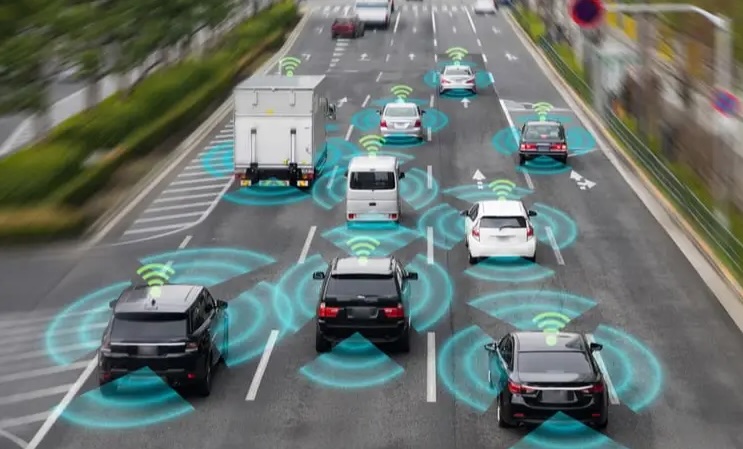
Artificial Intelligence (AI) is at the heart of the autonomous vehicle (AV) revolution, enabling self-driving cars to perceive their surroundings, make intelligent decisions, and navigate safely without human intervention. AI-powered autonomous vehicles promise to enhance road safety, reduce traffic congestion, and transform urban mobility, but their widespread adoption also comes with challenges such as regulatory hurdles, cybersecurity threats, and ethical concerns.
This article explores how AI powers autonomous vehicles, its role in safety enhancements, navigation systems, and future innovations, and the challenges that must be overcome to achieve fully autonomous transportation.
1. How AI Powers Autonomous Vehicles
Autonomous vehicles rely on machine learning (ML), computer vision, and deep neural networks to process vast amounts of real-time data. The Society of Automotive Engineers (SAE) defines six levels of automation:
| Level | Automation | Description |
|---|---|---|
| 0 | No Automation | Human driver controls everything |
| 1 | Driver Assistance | AI assists with steering or acceleration (e.g., Adaptive Cruise Control) |
| 2 | Partial Automation | AI handles steering and acceleration, but human intervention is required (e.g., Tesla Autopilot) |
| 3 | Conditional Automation | AI can drive autonomously in some conditions, but human supervision is needed |
| 4 | High Automation | Fully autonomous driving in geofenced areas (e.g., Waymo) |
| 5 | Full Automation | No human intervention required in all conditions |
Most modern autonomous vehicles operate at Level 2 or Level 3, but AI advancements are rapidly pushing towards Level 4 and Level 5 autonomy.
2. AI Technologies in Autonomous Vehicles
a) Computer Vision and Perception Systems
AI-powered computer vision allows autonomous cars to detect and interpret road signs, pedestrians, lane markings, and obstacles.
🔹 LiDAR (Light Detection and Ranging): Uses laser beams to create a 3D map of the environment.
🔹 Cameras: Capture real-time images to identify road conditions and traffic signals.
🔹 Radar Sensors: Detect objects in poor visibility (fog, rain, snow).
🔹 Ultrasonic Sensors: Assist in parking and close-range object detection.
📌 Example: Tesla Vision eliminates LiDAR in favor of AI-driven camera-based perception.
b) Machine Learning for Decision-Making
Self-driving cars learn from massive datasets collected from real-world driving experiences and simulations. AI analyzes past driving behaviors, traffic patterns, and accident scenarios to improve decision-making.
🔹 Reinforcement Learning: AI continuously learns optimal driving strategies by trial and error.
🔹 Neural Networks: Enable pattern recognition for predicting pedestrian movements and road hazards.
🔹 Predictive Analytics: Helps vehicles anticipate future events (e.g., a car suddenly braking ahead).
📌 Example: Waymo’s AI-powered software has driven over 20 million miles in real-world conditions and billions of miles in simulations.
c) AI-Powered Navigation and Mapping
AI enhances navigation systems by providing real-time route optimization, traffic analysis, and obstacle detection.
✅ High-Definition (HD) Maps: AI processes detailed 3D maps for precise navigation.
✅ GPS and Sensor Fusion: AI integrates GPS data with real-time sensor inputs to adapt to changing environments.
✅ Path Planning Algorithms: AI predicts and plans the safest and most efficient route for the vehicle.
📌 Example: Google’s Waymo uses AI-driven HD maps to navigate complex city environments with precision.
3. Enhancing Safety with AI in Autonomous Vehicles
One of the biggest promises of AI in self-driving cars is reducing human-caused accidents. According to the World Health Organization (WHO), human errors cause 94% of road accidents, including distracted driving, speeding, and intoxication. AI aims to eliminate these risks through:
a) Collision Avoidance Systems
AI-powered Advanced Driver Assistance Systems (ADAS) detect imminent collisions and take preventive actions such as:
✅ Automatic Emergency Braking (AEB) – Stops the vehicle to prevent crashes.
✅ Blind Spot Detection – Alerts drivers about vehicles in blind spots.
✅ Lane Departure Warning – Notifies drivers when they unintentionally drift out of their lane.
✅ Adaptive Cruise Control (ACC) – Maintains a safe following distance.
📌 Example: Volvo’s AI-driven City Safety System automatically brakes to avoid pedestrians and cyclists.
b) AI for Driver Monitoring
AI ensures driver safety by monitoring fatigue, distraction, and intoxication levels.
✅ Facial Recognition Technology: Detects drowsiness and alerts the driver.
✅ Voice Recognition AI: Identifies slurred speech or signs of impairment.
✅ In-Cabin Sensors: Monitor heart rate and stress levels to prevent accidents.
📌 Example: Tesla’s Driver Monitoring System tracks eye movement and hand position to ensure driver attentiveness.
4. AI and the Future of Transportation
AI-driven autonomous vehicles have the potential to redefine transportation by improving efficiency, reducing traffic congestion, and enabling new mobility solutions.
a) AI in Ride-Sharing and Robo-Taxis
Companies like Waymo, Uber, and Tesla are investing in self-driving taxi fleets to offer safe and affordable transportation.
✅ Reduced Costs → No human drivers = Lower fares.
✅ 24/7 Availability → Robo-taxis operate continuously.
✅ Traffic Reduction → AI optimizes routes for smoother traffic flow.
📌 Example: Waymo launched fully autonomous ride-hailing services in Phoenix, Arizona.
b) AI-Enabled Smart Cities
Autonomous vehicles will integrate with smart city infrastructure for:
✅ AI Traffic Management → AI-controlled signals reduce congestion.
✅ Vehicle-to-Infrastructure (V2I) Communication → AI enables cars to communicate with traffic lights, road sensors, and emergency services.
✅ Sustainable Transportation → AI-powered EVs will reduce carbon emissions and promote cleaner cities.
📌 Example: Singapore is testing AI-powered autonomous buses for public transport.
c) AI in Autonomous Freight and Logistics
Self-driving trucks and AI-driven delivery robots will revolutionize logistics.
✅ Faster Deliveries → AI optimizes delivery routes.
✅ Lower Costs → Reduces dependence on human drivers.
✅ 24/7 Operations → Autonomous trucks operate without breaks.
📌 Example: Einride’s AI-driven electric trucks operate without human drivers, reducing carbon footprints in logistics.
5. Challenges and Ethical Concerns
a) Cybersecurity Risks
Self-driving cars are vulnerable to hacking attacks. AI-driven systems must implement robust encryption and cybersecurity measures.
📌 Example: In 2015, hackers remotely took control of a Jeep Cherokee, exposing vulnerabilities in AI-driven vehicles.
b) Ethical Dilemmas in AI Decision-Making
AI must make split-second decisions in emergency situations. The “Trolley Problem” dilemma raises ethical questions:
📍 Should AI prioritize passenger safety or pedestrian lives?
📍 How should AI handle unpredictable human behavior?
c) Legal and Regulatory Barriers
Governments are still developing laws and policies for self-driving cars. Countries must address liability issues, insurance policies, and road safety regulations before full-scale deployment.
📌 Example: The EU and US are working on AI regulations for Level 4 and Level 5 autonomy.
Conclusion: The Road Ahead for AI in Autonomous Vehicles
AI is revolutionizing transportation, making self-driving cars safer, smarter, and more efficient. While challenges like cybersecurity, ethics, and regulations remain, AI-powered vehicles are set to transform urban mobility, logistics, and public transport.
As AI advances, fully autonomous vehicles may become a reality within the next decade, reshaping how we travel, commute, and interact with transportation systems. 🚗🤖💡